Evidence and research
Every figure on this site carries a named source and a year. Figures that cannot be sourced are not on this site.
This page holds the full basis for what Porto Dome claims and a clear line between what is already established and what the first site is designed to test.

Workforce & retention — the case a board will recognise
8 Million+
Europeans kept out of the labour market entirely by unpaid care.
(European Commission, European Care Strategy, 2022)
£2.9 Billion
The yearly cost to England of carers leaving employment.
(Pickard et al., Health & Social Care in the Community, 2018)
600 / Day
UK workers who leave their jobs completely to provide care.
(Carers UK)
Sourced Findings
More than 8 million Europeans — 7.7 million women and 450,000 men — are kept out of the labour market entirely by unpaid care responsibilities. (European Commission, European Care Strategy, 2022)
In the UK, around one in seven of any workforce is caring for someone older, disabled or seriously ill, and roughly 600 people a day leave work altogether to care. (Carers UK)
Over one in six job advertisements in Europe now relates to long-term care. (European Commission, European Care Strategy, 2022)
1.6 million more long-term care workers would need to be added by 2050 simply to keep coverage at today's level. (European Commission, European Care Strategy, 2022)
The cost of carers leaving employment is measurable: in England, an estimated £2.9 billion a year in social security payments and lost tax revenue (Pickard et al., Health & Social Care in the Community, 2018); in the Netherlands, informal care costs €17.5–30.1 billion a year, of which 12–17% are indirect costs — lost hours and exits from work (Elayan et al., European Journal of Health Economics, 2024).
Extrapolation Disclaimer:
Applying the Dutch ratio to Germany's population gives an indicative €70–120 billion a year, of which €8–20 billion would be indirect workforce cost. This is an extrapolation by the author from Elayan et al., not a measured German figure, and is offered as an order of magnitude rather than a finding.
The ILO estimates that Member States recoup, on average, around 55% of what they invest in the care sector through increased tax and social security contributions. (Cited in European Commission, European Care Strategy, 2022)
Demographic & health — why this is arriving now
30.8 million people in the EU are potentially in need of long-term care today. By 2050 it will be 38.1 million. (European Commission, European Care Strategy, 2022)
One in three working-age Europeans — 106 million people — report care responsibilities. (Eurostat, 2018)
Around 52 million people across the EU provide informal long-term care on a weekly basis — close to 80% of all long-term care provision. (European Commission, European Care Strategy, 2022)
Unpaid care across Europe is worth around €576 billion a year, roughly 3.6% of EU GDP. (World Health Organization, 2023)
Europe faces a projected shortage of 4.1 million healthcare workers by 2030. (European Parliament, 2025)
Care for a parent begins on average at 59.6, typically while people are still in paid work, and earlier for workers in lower-paid occupations. (Alonso-Perez et al., Ageing & Society, 2026)

Where European policy already points
The European Care Strategy (2022) observes that care located at or near the workplace can reduce the logistical burden on parents, particularly in jobs requiring physical presence, and that different working patterns require care at atypical hours — for shift and night workers.
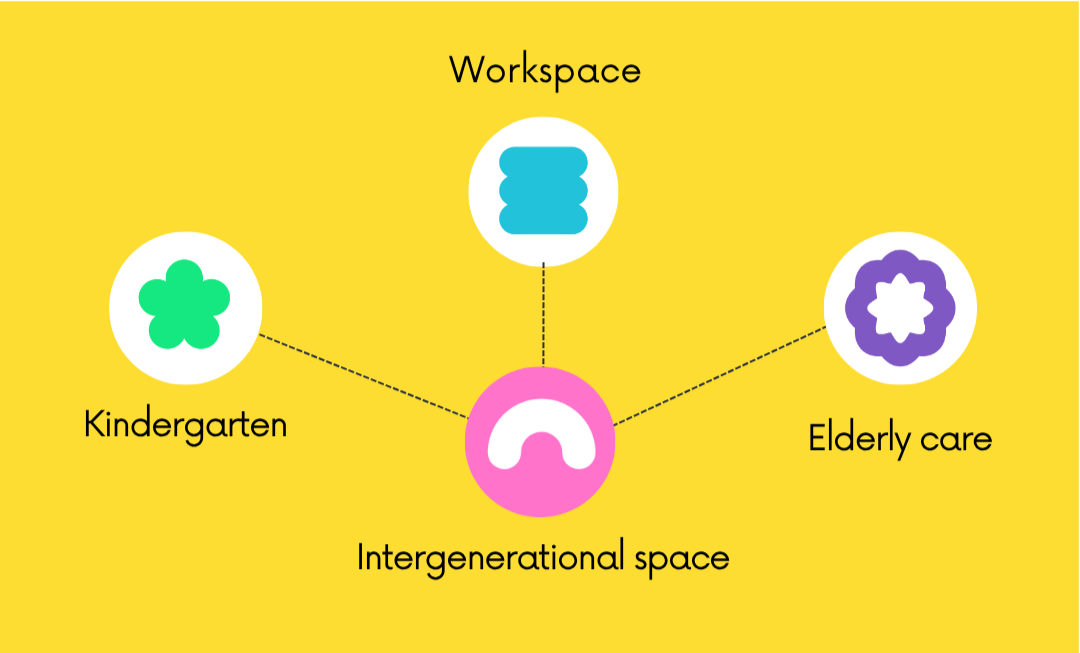
The same document notes that multigenerational settings can foster intergenerational contact and solidarity while supporting independent living.
It calls for the mapping of available infrastructure and gap analysis as a route to cost-effectiveness, and invites Member States to use EU funding for early childhood education and care — including at parents' workplaces.
Two halves of one idea, in a single policy document, never joined. Porto Dome is what joins them.

What the first site will test
The following are hypotheses, not results. Nothing below has been measured by Porto Dome, because no site exists yet. Setting them out now is how the first site produces evidence rather than anecdote.
Absence reduction. Whether co-locating work and care reduces care-related absence and unplanned reductions in hours.
Staff retention. Whether it improves recruitment and retention for care operators and health systems.
Participant wellbeing. Whether it measurably reduces social isolation and improves wellbeing for the older people and children who use it.
That is where you come in.
If you work on intergenerational practice, workforce retention, ageing or the built environment, the evaluation framework is open to collaboration from the start.